



India
This resource page consolidates key academic literature, policy analyses, and legal frameworks that are foundational to understanding how CLTs can be adapted and implemented in the Indian context.
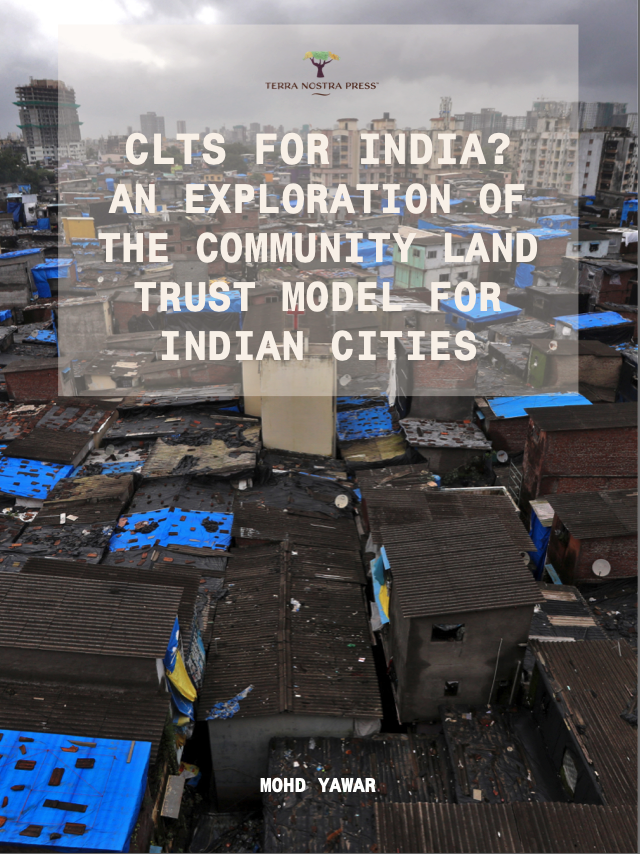
The International Center for Community Land Trusts (ICCLT) is pleased to announce the release of the working paper, “CLTs for India? An Exploration of the Community Land Trust Model for Indian Cities”, by Mohd Yawar. This exploratory study, conducted as a part of the ICCLT’s Global South Community Land Trust Initiative, explores the potential of Community Land Trusts (CLTs) as an alternative tenure model for Indian cities facing widespread tenure insecurity and displacement. This study provides an in-depth legal analysis to assess the applicability and institutional feasibility of adapting the CLT model within India’s existing legal and institutional frameworks. The paper is intended to be a foundational resource for initiating dialogue and spreading the word about CLTs in India. By demonstrating how the CLT model can be operationalized, this research aims to transform the concept from an abstract idea into a practical option on the Indian urban housing policy menu.
Additional Resources
This resource page consolidates key academic literature, policy analyses, and legal frameworks that are foundational to understanding how CLTs can be adapted and implemented in the Indian context. By examining landmark papers, state cooperative laws, and emerging case studies such as Magarpatta City, this resource page offers a comprehensive lens on the theoretical underpinnings, governance mechanisms, and practical challenges involved in operationalizing CLTs in India’s dynamic urban landscape. This curated collection is aimed at scholars, policymakers, practitioners, and grassroots organizations seeking to explore community-based land governance as a means to equitable, long-term housing solutions.
Academic Papers
Title: Institutional potential of housing cooperatives for low-income households: The case of India
Author: Sukumar Ganapati
Citation/Reference: Sukumar, G. (2001). Institutional potential of housing cooperatives for low-income households: The case of India. Habitat International, 25, 147–174
Article Link: https://www-sciencedirect-com.uaccess.univie.ac.at/science/article/pii/S0197397500000229
Abstract: I analyze the institutional potential of housing cooperatives to fulfill housing objectives of low-income households, using three Indian cities (Mumbai, Chennai, and New Delhi) as empirical basis. I propose that there are two dimensions affecting the potential: (i) internal organizational features of the cooperative and (ii) external institutional context. At the organizational level, although cooperatives have certain inherent benefits for low-income households, they face collective action problems that need to be overcome. Potential benefits vary with the form of cooperatives. At the institutional level, evolution of cooperatives is set in both the local housing market and the local institutional framework. The institutional framework could help or hinder in realizing the potential benefits in a given housing market by lowering or raising transaction costs of formation and functioning of cooperatives. In India, the national institutional context promoted cooperatives as a means for low-income households. However, these households have benefited to different degrees in the three cities. While cooperatives have been most effective in Mumbai, they have been less effective in Chennai and New Delhi. The comparative examination holds three lessons for housing policy. The first lesson is that both local housing market and institutional framework have influenced the form and functioning of housing cooperatives. The second lesson is that minimal state controls aid cooperatives to perform multifarious functions. The third lesson is that development of an institutional structure supporting cooperatives lowers the transaction costs of their formation and functioning, which is to the benefit of low-income households.
Description & Relevance to CLTs: The paper by G. Sukumar analyzes the institutional potential of housing cooperatives to achieve the objectives of low-income households, using Mumbai, Chennai, and New Delhi as case studies. The analysis emphasizes two key dimensions affecting the success of co-operatives: internal organizational features and the external institutional context, which includes the local housing market and the regulatory framework. The study concludes that co-operatives were most effective in Mumbai and less so in Chennai and New Delhi. Key lessons highlight that minimal state controls aid co-operatives in performing diverse functions, and the development of supporting institutional structures lowers the transaction costs of their formation and functioning.
This research is highly relevant to the feasibility of Community Land Trusts (CLTs) because the registered society/cooperative framework is identified as a viable legal vehicle for piloting CLTs in India (Yawar, 2025). The paper identifies Tenure Cooperative Housing Societies as the most stable form of co-operative, offering the most prospects as a policy tool for low-income households. This form, exemplified by the Tenant Ownership Housing Society in Mumbai, provides a direct structural model for the CLT’s mechanism of dual ownership—where the co-operative holds the legal title to the land and the member has occupancy rights to the unit. Furthermore, these Tenure Co-operatives have the intrinsic ability to control speculation by limiting the individual household’s ability to sell the land in the open market and by potentially sharing the proceeds when a unit is sold. This capability to institutionalize limitations on speculative profit is essential for realizing the CLT mission of permanent affordability. In Mumbai, this co-operative tenure was successfully adapted by public housing authorities and NGOs for slum regularization schemes specifically to prevent “speculative selling” among low-income beneficiaries.
Title: A Century of Differential Evolution of Housing Cooperatives in Mumbai and Chennai
Author: Sukumar Ganapati
Citation/Reference: Ganapati, S. (2008). A Century of Differential Evolution of Housing Co-operatives in Mumbai and Chennai. Housing Studies, 23(3), 403–422.
Article Link: https://doi.org/10.1080/02673030802029982
Abstract: Since their inception at the beginning of the 20th century, the evolutionary paths of housing co-operatives have diverged in Mumbai and Chennai. Housing co-operatives in Mumbai have been principally Tenure co-operatives (i.e. for collective ownership and management). In Chennai they have been mainly Finance co-operatives (i.e. for providing loans to members). This paper makes a comparative institutional analysis of the two cities to examine the divergent evolution. The examination is important for informing the institutional conditions that enable co-operatives to flourish. Four institutional aspects are examined in this context: the local housing market, local housing policies, role of state government and co-operative institutional support structures.
Description & Relevance to CLTs: The paper “A Century of Differential Evolution of Housing Co-operatives in Mumbai and Chennai” by Sukumar Ganapati provides a comparative analysis of how housing co-operatives evolved differently in the former Bombay and Madras provinces since the early 20th century. In Mumbai (Maharashtra), the dominant form became the Tenure co-operative, organized for collective ownership and management, which grew in significance after India’s Independence. These included tenant ownership types, where the co-operative owned the land and members leased their housing units. In contrast, Chennai (Tamil Nadu) primarily saw the emergence of Finance co-operatives, focused on providing loans for housing construction and repairs.
This historical analysis is highly relevant to the feasibility of Community Land Trusts (CLTs) in India because the registered society/cooperative framework is identified as a viable vehicle for initially piloting CLTs (Yawar, 2025). The Tenant Ownership Housing Society (TOHS) model, prevalent in Mumbai, serves as a direct legal and structural precursor, mirroring the core CLT principle of dual ownership, the cooperative collectively owns the land while members lease the houses. Crucially, the paper notes that co-operatives in Maharashtra were granted greater operational autonomy, as the Registrar’s office adopted an ‘advisory’ role. This autonomy is vital because it means the co-operative structure can be flexibly adapted, allowing CLT-specific features like resale restrictions and affordability covenants to be legally embedded into the society’s bylaws.
Title: Magarpatta Story: Farmers Building Sustainable Cities
Author: Satish Magar
Citation: Magar, S. (2011). Magarpatta story: Farmers building sustainable cities (Occasional Publication 31). India International Centre.
Article Link: https://aws-static.iicdelhi.in/s3fs-public/2020-11/163615September192011_IIC%20Occasional%20Publication%2031.pdf
Description & Relevance to CLTs:The establishment of Magarpatta City in Pune illustrates the practical application of the Companies Act structure for large-scale collective landholding, although its fundamental goals diverge from the CLT model. The project originated when approximately 120 farmer families, acting as original landowners, came together to preserve their land from being acquired by the government or local developers. They pooled their 430 acres of land and formed the Magarpatta Township Development and Construction Company Limited (MTDCCL), becoming shareholders proportional to their holdings. This project was based on a revenue sharing model designed to convert their land into a “value-added fine product” and provide returns in perpetuity.
Magarpatta City shares structural features with CLTs by establishing a form of collective land management. MTDCCL retained land ownership, using long-term leasing for its extensive IT Park (Cybercity) to ensure a perpetual source of income for the farmer shareholders, mirroring the CLT principle of holding land as a long-term asset. Furthermore, MTDCCL established a City Council to ensure the participation of residents in the management of cultural and social activities. However, the key distinction is mission: Magarpatta was a for-profit enterprise focused on maximizing returns. The revenue-sharing model allowed shareholders to receive the benefit of appreciation, leading to a value increase of over 900% in the land value alone between 2000 and 2011. This stands in direct contrast to the CLT’s mission of permanent affordability and land decommodification, which mandates resale restrictions to cap appreciation for the benefit of future low-income buyers.
Title: Magarpatta Story: Farmers Building Sustainable Cities
Author(s): Amit Gupta, Sucheta Dalal, Debashis Basu, and Amita Joseph
Citation: Gupta, A., Dalal, S., Basu, D., & Joseph, A. (2012, November). Magarpatta City: Farmers Direct Investment (FDI) (Working Paper No. 384). Indian Institute of Management Bangalore.
Article Link: https://papers.ssrn.com/sol3/Delivery.cfm/SSRN_ID2179495_code1871889.pdf?abstractid=2179495&mirid=1&type=2
Abstract: Magarpatta City covers 430 acres of land that was owned by about 120 farmer families with 800 individuals. These farmers joined together to form the Magarpatta Township Development and Construction Company Limited (MTDCCL) and developed the city, thereby realizing their dream of converting their land into a value-added finished product that gave them benefits and returns in perpetuity. Satish Magar is the de-facto leader of the group because of his educational accomplishments, political connections, largest land holding and the trust that the Magar community has in his leadership and ability to take them collectively to a point where all of them collectively benefit.
Magarpatta City was conceived as an integrated planned township with multiple commercial zones, residential neighborhoods, school, hospital, shopping malls, hotels, restaurants, and recreation areas. These were designed to be contemporary with futuristic features and included a state-of-the-art IT Park called Cybercity that provided international facilities to leading global IT giants. Being encompassed by verdant greenery and pollution-free environment has added to the township’s allure. The city has its own rainwater harvesting, garbage segregation and waste management, biogas plant, vermiculture, plant nursery, and solar water heating arrangements that create a self-sustainable system and ensure further enhancement of the environment. A walk-to-work-home-recreation lifestyle is at the core of Magarpatta. All these facilities came with complete support to run new cutting-edge information technology infrastructure, full power backup, ample parking, stringent security, and strict adherence to fire safety norms.
The case describes the process that the farmers went through to convert the raw material that they possessed (land) to a finished product, namely the Magarpatta Township. It illustrates the changes that the real estate sector is going through in India, issues related to getting government permissions for a township, conceptualizing, designing, planning, and constructing the township, marketing and financing the township, benefits that the township had for the farmers, residents, Pune city, business environment, and developing an organization that can carry forward the process of replicating the success of this model of real estate development.
Title: Policy Approaches to Affordable Housing in Urban India
Author(s): IIHS Research Team: Gautam Bhan, Geetika Anand, Swastik Harish. Contributing Author: Prasad Shetty.
Citation: Bhan, G., Anand, G., Harish, S., & Shetty, P. (2014). Policy approaches to affordable housing in urban India: Problems and possibilities (IIHS-RF Policy Paper Series: Urban Housing). Indian Institute for Human Settlements.
Article Link: https://iihs.co.in/knowledge-gateway/wp-content/uploads/2015/08/iihs_rf_housing_reduced.pdf
Description & Relevance to CLTs: This paper, published in 2014, sets out to address the critical policy challenges hindering the provision of affordable housing in Indian cities, focusing on “actually existing practices, policies and paradigms”. The central premise is that neither the state nor the market can deliver the required stock of affordable housing at scale. It systematically addresses ten “dynamics” influencing urban housing, covering legal rights, land scarcity, planning failures, and financing issues. Crucially for the Community Land Trust (CLT) model, the paper grapples with “Dynamic 3: Titles could gentrify, but restrictions may distort”. This dynamic frames the core challenge faced by any affordable housing intervention: how to grant low-income residents secure tenure without allowing the asset’s value to appreciate wildly, leading to resale and subsequent market-induced displacement.
Although the specific terms “Community Land Trust” or “Community Land Reserve” are not used in the text, the policy solutions recommended are conceptually aligned with the perpetual affordability mechanisms that define CLTs. The paper explicitly suggests that Community or co-operative titling represents a “middle ground” between individual ownership (which risks immediate resale at high market rates) and overly restrictive state control (which distorts the market). This model is designed to regulate exchange by restricting sale to households of similar socio-economic status, effectively preventing displacement and keeping the housing affordable for the target group in perpetuity. This mechanism, where the community holds the property right and restricts appreciation, mirrors the core function of a CLT ground lease and resale formula. The paper cites the successful Baan Mankong scheme in Thailand, noting that its upgrading projects are structured around community leaseholds precisely to prevent market-based displacement while providing secure tenure.
Furthermore, the paper addresses the fundamental need for securing land supply and ensuring legal protection, which are essential prerequisites for CLTs to operate. It counters the popular claim of land scarcity by pointing out that a significant proportion of land occupied by informal settlements is publicly held, often by Urban Local Bodies (ULBs). It suggests leveraging this public land through interventions such as converting occupied land into “social rentals” where the ULB acts as landlord, gaining revenue while providing secure tenure. Legally, the paper advocates for the institutionalization of Inclusionary Zoning, recommending the creation of instruments similar to the Special Zone of Social Interest (ZEIS) used in Brazil. The ZEIS approach uses zoning to mark land for social and public interest, explicitly protecting informal settlements from forced evictions and ensuring that land remains accessible for regularization and low-income housing. By promoting mandatory land reservation policies (like those in Rajasthan), community titling, and legal protections against displacement, the paper establishes the necessary policy environment, including legal, institutional, and land-use frameworks,
Title: Community Land Reserves
Author: Shirish B. Patel
Citation/Reference: Shirish B. Patel (2015). Community Land Reserves. Economic and Political Weekly, Vol. 50, No. 46–47, pp. 21–23.
Article Link: https://www.cooperative-individualism.org/patel-shirish_community-land-reserves-2015-nov.pdf
Abstract: Community Land Reserves (called Community Land Trusts in the US) have been in existence around the world for over 40 years. They are non-profit organisations with a mission to provide affordable housing to low income groups, for all time. Someone starts one off by providing a gift of land. The organisation then takes this gift of land off the market to hold it in trust forever thereafter. Ownership of the land remains with the organisation, which cannot sell it. Individual parcels are given out to owners who build on them and own the construction but not the land. On resale, the owner recoups the cost of his construction, adjusted to present-day value, but not the appreciation in land value. As a result, the incoming occupant can also get housing at an affordable price, because it is unburdened by land value. Critical to success are the format of governance of the organisation and the resale formula.
Description & Relevance to CLTs: Patel’s article Community Land Reserves is the first published paper to introduce and adapt the Community Land Trust concept for the Indian context. It proposes Community Land Reserves (CLRs) as a mechanism to separate land ownership from building ownership, ensuring that housing remains permanently affordable. In this model, a non-profit organization owns the land and leases it to residents, who own the structures. On resale, residents recover only the inflation-adjusted cost of the building, while the land value appreciation is retained in the community trust.
Patel outlines a tripartite governance system comprising residents, community members, and public officials to guarantee fairness, participation, and transparency. He also explains how CLRs could be registered as Section 8 non-profit companies under Indian law, operating through existing housing and planning legislation.
This article marks the first theoretical and policy-oriented discussion of CLTs in India. It lays the groundwork for adapting CLT principles to Indian legal frameworks and urban development challenges. Patel’s CLR model offers a practical pathway to combine tenure security, affordability, and community governance, making it a foundational reference for any discussion on CLTs in India.
Relevant Laws
Links
- https://drive.google.com/file/d/1Vz7gPZ2R25lmi_PZCMlF3ugez5i0ctdC/view?usp=drive_link
- https://drive.google.com/file/d/1JD4ivqNP1xobL0WTuCt0TDJh_cNJw6iq/view?usp=drive_link
Description & Relevance to CLTs: The feasibility of implementing Community Land Trusts (CLTs), can be substantially analyzed through the lens of the Delhi Co-operative Societies Rules, 2007 (Delhi Rules). This legal framework is particularly relevant because it already institutionalizes the concept of collective property holding and establishes mechanisms for communal governance and financial enforcement—all essential pillars of the CLT model.
The critical linkage for the CLT model is found in the rules about Co-operative Housing Societies. This classification directly accommodates the core CLT principle of dual ownership and the preservation of common land. While the society collectively holds title to the land, ensuring it remains out of the speculative market, members are granted secure occupancy rights to their dwelling units. The structure defined in the Delhi Rules, which dedicates Chapter IX to “SPECIAL PROVISIONS FOR CO-OPERATIVE HOUSING SOCIETIES,” mandates collective management of assets, repairs, and maintenance of “Common areas and facilities,” confirming the society’s role as perpetual land steward.
To function effectively as a CLT aimed at perpetual affordability, a co-operative must impose controls on who can join and how property is resold. The Delhi Rules facilitate this through the requirement that the society’s objectives and membership qualifications must be approved by the Registrar. This requirement allows for the embedding of a Limited Appreciation Formula and income-based eligibility criteria directly into the co-operative’s bylaws, ensuring that membership is restricted to the target low-income population, and that future resale prices remain affordable. The rules also set forth stringent requirements concerning membership disqualification, prohibiting those who already own property in Delhi, which serves as a powerful anti-speculation mechanism vital to the CLT ethos.
Furthermore, the legal framework ensures the financial viability and enforceability necessary for a lasting CLT organization. The Rules contain robust mechanisms for the recovery of dues, allowing cooperative housing societies to recover outgoings and arrears of dues as “arrears of land revenue” through a certificate granted by the Registrar. This specific enforcement power is paramount, guaranteeing that the perpetual maintenance fund for the common land and facilities can be sustained, thus supporting the long-term mission of the CLT. By legally structuring collective ownership and regulating private interest through enforceable financial and governance mandates, the Delhi Rules provide a strong template for implementing and scaling CLTs in urban Delhi.
Indian Trusts Act, 1882: https://drive.google.com/file/d/14a9gTRYxsHGRQOpDS7S9bzFqPdROvXlN/view?usp=sharing
Companies Act, 2013: https://drive.google.com/file/d/13QPjZo1roP8kbM71_VhrElvm0nS5R7zL/view?usp=sharing
Societies Registration Act, 1860: https://drive.google.com/file/d/1iMkFzFHYCkDHp7DZTvkt4WquuEAj34kk/view?usp=sharing
Description & Relevance to CLTs: The paper by Mohd Yawar (2025) explores the potential for establishing Community Land Trusts (CLTs) in India by utilizing the country’s existing legal frameworks, concluding that three primary legal entities can serve as organizational structures: charitable trusts, Section 8 companies (under the Companies Act, 2013), and registered societies (under the Societies Registration Act, 1860). Based on an evaluation of the democratic requirements inherent in the CLT model, the research identifies the registered society model (including cooperative housing societies) as the most viable vehicle for initially piloting CLTs in India. This framework is highly compatible with the CLT’s democratic governance structure, allowing for member participation, autonomy, and flexible rule-setting necessary for grassroots projects. In contrast, the Section 8 company model, while offering high institutional credibility, is considered appropriate for CLTs that are well-established, operating at a large scale, or require extensive partnerships with government and international actors
The following table and detailed summary compare the efficacy of using a Public Charitable Trust, a Section 8 Company, or a Registered Society/Cooperative as the legal vehicle for establishing a Community Land Trust (CLT) in India.
| Feature | Trust (Indian Trusts Act, 1882) | Section 8 Company (Companies Act, 2013) | Registered Society/Cooperative (Societies Registration Act, 1860, and Co-operative Acts) |
| Governing Law & Purpose | Indian Trusts Act, 1882, governs private trusts (state laws govern public trusts). A “trust” is an obligation annexed to the ownership of property, arising from confidence reposed for the benefit of a “beneficiary”. The purpose must be lawful. | Companies Act, 2013. Established for charitable or not-for-profit purposes; distribution of profits is prohibited, and they must comply with statutory reporting norms. | Societies Registration Act, 1860. Formed for literary, scientific, or charitable purposes, or the promotion of the general welfare of members. |
| Core CLT Alignment | Moderate legal security, but the governance structure conflicts with democratic CLT principles. | High institutional credibility, suitable for large-scale partnerships, but a rigid and often top-heavy governance structure. | Most Viable: Highly flexible, structurally democratic, and easily adaptable for grassroots community control. |
| Governance & Democracy | Weak Alignment. Trustees are typically appointed, holding a fiduciary character. Governance is hierarchical, following the directions of the author of the trust. There is limited scope for democratic community involvement. | Weak Alignment. Governed by Directors and Key Managerial Personnel. Structure risks being distant and bureaucratic. Decision-making requires ordinary or special resolutions. | Strong Alignment. Managed by a governing body elected by the general membership. Highly compatible with CLT’s participatory model. The Society sues or is sued in the name of the designated officer, as determined by the rules. |
| Perpetuity & Land Holding | Strong Capacity. The land (“trust property”) is held in perpetuity by the trustee. However, if there is only one competent beneficiary, they may require the trustee to transfer the trust property to them immediately, posing a fundamental risk to perpetual land holding. | Strong Capacity. Can hold land in perpetuity. Must file details of all charges or floating charges affecting the property. | Strong Capacity. Can hold land in its own name. On dissolution, no member receives profit, and assets must be transferred to another society with similar objectives. Bylaws can mandate supermajority votes for dissolution. |
| Operational Flexibility | Rigid. Trustees must adhere strictly to the trust instrument. Delegation of discretionary duties is restricted. Trustees generally cannot derive financial benefits. | Bureaucratic. Setup is procedurally intensive, requiring compliance with extensive rules for financial statements, audits, and articles/memorandum alteration. | High Flexibility. Bylaws can be tailored to incorporate CLT principles like resale restrictions and Limited Appreciation Formulas. Societies are explicitly enabled to alter, extend, or abridge their purposes. |
| Accountability & Liability | Trustees are personally liable to make good any loss resulting from a breach of trust. Liability is generally unlimited. Co-trustees are jointly and severally liable if one enables the other’s breach. | Directors and officers are subject to high penalties and fines for non-compliance. General liability is limited. Penalties exist for fraud. | Must keep regular accounts and undergo an annual audit. The Registrar has the power to inspect records and seize accounts if necessary. Liability for penalty accrual under bye-laws. |
Links
- https://drive.google.com/file/d/1SFz1DcsTNt6M0hre_47PLMdbvBGsXEKR/view?usp=drive_link
- https://drive.google.com/file/d/1c917fMQ1-8R-U66SqqPclsiyGM33ErVL/view?usp=drive_link
Description & Relevance to CLTs: The feasibility of implementing Community Land Trusts (CLTs) or Community Land Reserves (CLRs) in India is substantially supported by and relies upon the existing framework of state-level cooperative laws, specifically drawing upon the principles embedded in the Maharashtra Co-operative Societies Act of 1960 (the Act) and the accompanying Rules of 1961 (the Rules). The relevance of these laws lies in their capacity to accommodate the foundational legal requirements of the CLT model, particularly concerning perpetual collective land ownership and the enforcement of affordability restrictions.
The fundamental relevance is established by classifying a potential CLT/CLR as a Tenant Ownership Housing Society (TOHS) under the Act. Rule 10(1) and Rule 4(e)(vii)(a) explicitly classify and provide registration fees for Housing Societies, including Tenant Ownership Housing Societies, which are defined as societies where the land is held either on a lease-hold or free-hold basis by the Society, while the houses are owned by the members. This arrangement is critical as it explicitly recognizes and institutionalizes the dual ownership structure essential to a CLT: the cooperative retains the common land aspect by owning the underlying property, while members acquire legal interest and ownership of the housing structure built upon it.
To ensure the permanence and public benefit central to the CLT mission, the cooperative framework allows for the customization of its purpose and membership criteria through its bylaws. The Registrar has the authority to require a society to make bylaws concerning “the objects of the society” and “the terms and qualifications for admission to membership”. This regulatory power enables the incorporation of key CLT features directly into the cooperative’s constitutive documents. For instance, the bylaws can mandate the core objective of providing permanently affordable housing and institute income-based eligibility criteria for membership. Furthermore, the Registrar’s powers to approve or modify bylaws ensure that measures like a Limited Appreciation Formula are legally binding, thus restricting the resale price of the housing units to preserve affordability for future low-income buyers.