


Terra Nostra Press
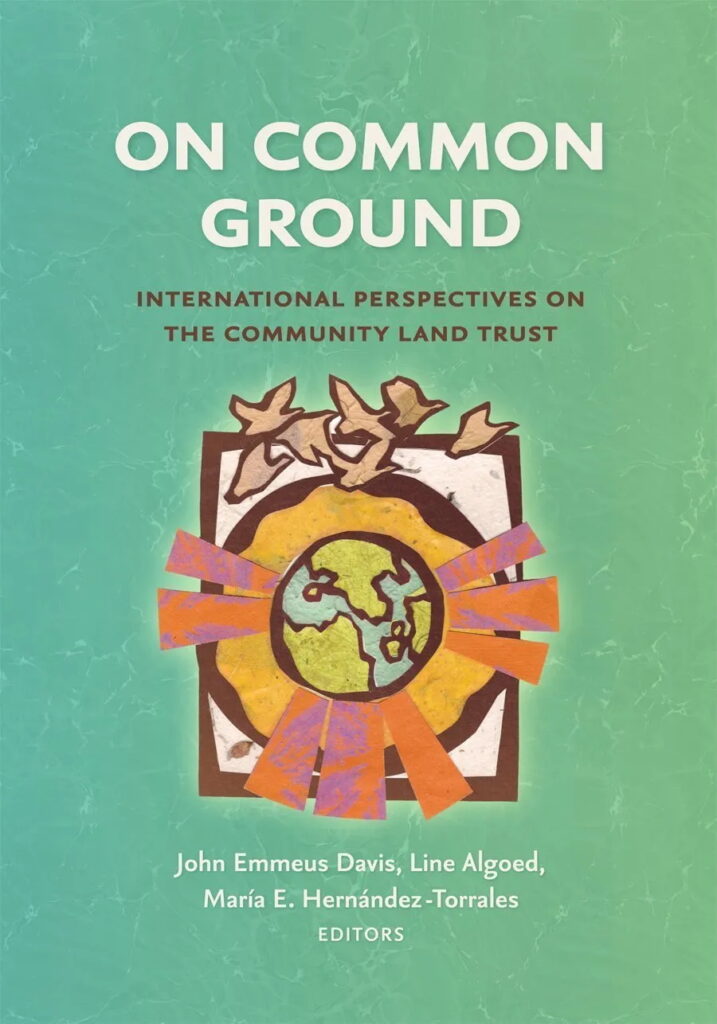
On Common Ground: International Perspectives on the Community Land Trust
Twenty-six original essays by forty-two scholars and practitioners from a dozen countries, tracing the growth and diversification of the international CLT movement.
About this book
Edited by: John Emmeus Davis, Line Algoed and María E. Hernández Torrales
Published: 2020
Length: 502 pages, 70 illustrations, index
Paperback: ISBN 9781734403022 · US$27.50
Hardcover: ISBN 9781734403008 · US$45.00
Ebook: ISBN 9781734403015 · US$15.00
Buy the book
Ordering for your organization? Nonprofit organizations receive a 40% discount on orders of ten or more books. See Bulk Orders.
About the book
Fifty years ago, African-American activists in Albany, Georgia extended their political fight for civil rights into the economic realm by creating New Communities Inc. They had come to believe that owning land was essential to securing greater independence for their people. But landownership was out-of-reach for most African-Americans in the Deep South of the 1960s and too easily lost if they did acquire a small farm, a plot of land, or a house in town. The visionary founders of New Communities concluded, therefore, that community ownership would be a more secure form of tenure. Community-owned land could be combined, moreover, with the individual ownership of newly built houses, offering low-income people an opportunity to become homeowners. Community-owned land could also provide a platform for the cooperative organization of various enterprises, offering low-income people a chance for economic prosperity.
This ingenious hybrid, blending multiple owners and uses under the watchful eye of a community-controlled, nonprofit organization, was the prototype for what eventually became, after some fine-tuning in subsequent years, the “community land trust” (CLT).
There are now over 260 CLTs in the United States and over 300 in England and Wales. Others have been established in Australia, Belgium, Canada, and France. Interest has also been rising in Germany, Ireland, Italy, the Netherlands, Portugal, Scotland, and Spain. More recently, the seeds for new CLTs have been scattering across the Global South as well, inspired by a high-profile CLT in Puerto Rico that is securing the homes of hundreds of families residing in informal settlements in San Juan. This has attracted the attention of communities struggling with land and housing insecurity throughout Latin America and the Caribbean, ranging from the urban residents of Brazil’s favelas to indigenous peoples in rural regions where their customary, collective use of homesteads, forests, and watersheds is often unprotected by formal title. Activists in Africa and South Asia have also taken note, weighing whether a CLT might promote equitable and sustainable development in their own communities.
On Common Ground: International Perspectives on the Community Land Trust explores the growth of this worldwide CLT movement. The book’s twenty-six original essays, contributed by forty-two authors from a dozen different countries, cover five general topics: BRIGHT IDEAS survey the conceptual and practical justifications for community-led development on community-owned land; NATIONAL NETWORKS examine the proliferation and cross-pollination of CLTs in the Global North; REGIONAL SEEDBEDS explore the potential for CLT development in the Global South; URBAN APPLICATIONS showcase the success of selected CLTs in London, Brussels, Boston, Burlington, and Denver, a handful of highly productive CLTs that are providing affordable housing, spurring neighborhood revitalization, and securing land for urban agriculture; CRITICAL PERSPECTIVES reflect on the changing environment to which CLTs must adapt if they are to “go to scale,” while remaining accountable to the communities they serve.
“The visionary leaders, communities and organizations featured in this book are at the forefront of a broader national and global movement to recalibrate the relationship between governments and markets in housing and development policy.”
JERRY MALDONADO, Ford Foundation (from the Foreword)
Reviews and press
“Overall, the editors masterfully compile original essays into a persuasive argument for solving the international land rights and housing crisis. On Common Ground resoundingly demonstrates the transformative possibilities that CLTs can produce across the globe when community organizing, operation, and ownership of land connects and expands. Given the target audience includes those working in housing and community development, community organizing, and policy analysis, positions many planners hold or engage, I highly recommend this book to planning professionals and academicians alike.”
Jeffrey S. Lowe, Journal of the American Planning Association
“On Common Ground is an essential read for those interested in addressing the affordable housing crisis, which will continue to be exacerbated by the negative economic impacts of COVID-19. Due to a long and painful history of institutional racism and the lack of responsive action by many elected leaders, home ownership and quality rental housing have historically been denied to persons of color. The book examines the growth of the community land trust (CLT) model and how it has adapted in urban and rural environments, offering readers a thoughtful and empathetic overview of how to start and scale a CLT to ensure that affordable housing incorporates its residents. The book leaves readers with a sense of hope for the future and practical ways in which this model can be built and sustained.”
Robert Burns, Senior Vice President, CitiBank, and Board President of Grounded Solutions Network
“Around the world, the COVID-19 pandemic and its economic effects threaten to exacerbate already severe inequities, especially with regards to the ownership, access, and control of land and housing. In the United States, as eviction moratoriums in many states and localities come to an end and jobs remain scarce, experts are predicting a possibly unprecedented wave of displacement and homelessness. Against this bleak backdrop, a new book offers a ray of hope. On Common Ground, edited by John Emmeus Davis, Line Algoed, and María Hernández-Torrales, documents how interest in one of the more exciting new economic models to emerge in recent decades, the Community Land Trust (CLT), is spreading around the world.”
Thomas Hanna, Research Director, Democracy Collaborative
Contents
26 chapters
- Figures
- Foreword: Jerry Maldonado, Ford Foundation; David Ireland, World Habitat
- Introduction: On Common Ground
Part One. Bright Ideas: Surveying the Diverse Landscape of Common Ground: Structures, Strategies, and Justifications
- In Land We Trust: Key Features and Common Variations of Community Land Trusts in the US
- The Once and Future Garden City
- Common Ground: Community-Owned Land as a Platform for Equitable and Sustainable Development
- Making a Case for CLTs in All Markets, Even Cold Ones
- Challenges for the New Kid on the Block—Collective Property
Part Two. National Networks: Examining the Proliferation and Cross-Pollination of CLTs in the Global North
- From Model to Movement: The Growth of Community Land Trusts in the United States
- Origins and Evolution of Urban Community Land Trusts in Canada
- Messy Is Good! Origins and Evolution of the CLT Movement in England
- Beyond England: Origins and Evolution of the Community Land Trust Movement in Europe
Part Three. Regional Seedbeds: Exploring the Potential for CLT Growth in the Global South
- Collective Land Tenure in Latin America and the Caribbean, Past and Present
- Seeding the CLT in Latin America and the Caribbean: Origins, Achievements, and the Proof-of-Concept Example of the Caño Martín Peña Community Land Trust
- Community Land Trusts in Informal Settlements: Adapting Features of Puerto Rico’s Caño Martín Peña CLT to Address Land Insecurity in the Favelas of Rio de Janeiro, Brazil
- A Watershed Land Trust in Honduras: Profile of Foundation Eco Verde Sostenible
- Seeding the CLT in Africa: Lessons from the Early Efforts to Establish Community Land Trusts in Kenya
- The Origins and Evolution of the CLT Model in South Asia
Part Four. Urban Applications: Measuring the Progress of High-Performing CLTs in Selected Cities
- Take a Stand, Own the Land: Dudley Neighbors Inc., a Community Land Trust in Boston, Massachusetts
- Lands in Trust for Urban Farming: Toward a Scalable Model
- The Best Things in Life Are Perpetually Affordable: Profile of the Champlain Housing Trust, Burlington, Vermont
- Stewardship of Urban Real Estate for Long-Term Community Benefit: Profile of the Urban Land Conservancy in Denver, Colorado
- London Community Land Trust: A Story of People, Power, and Perseverance
- From Pressure Group to Government Partner: The Story of the Brussels Community Land Trust
Part Five. Critical perspectives: Meeting the Challenges of a Changing Environment
- The Burden of Patience in a Long March Toward Racial Justice
- A Reflection on the Bioethics of Community Land Trusts
- Community Control of Land: Thinking Beyond the Generic Community Land Trust
- Preserving Urban Generativity: The Role of Porous Spaces in CLT Projects
- Better Together: The Challenging, Transformative Complexity of Community, Land, and Trust
- Contributors
- Index
Chapter descriptions
26 chapters
Select a chapter to read its description.